
Educational Psychology: Individual Differences & Assessment
Observe a classroom scenario by referring to the diagram provided:
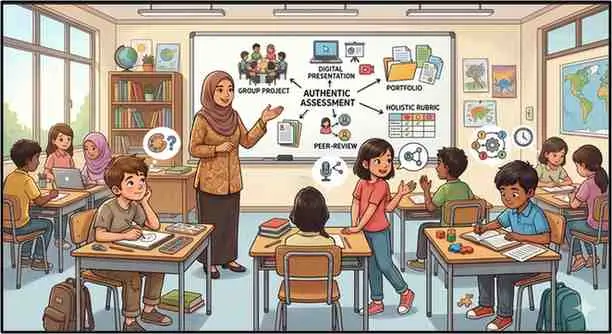
Puan Sarah is an English teacher at a rural school. She notices that her class’s monthly test results have declined not because the students do not understand the material, but because the existing written testing methods are not motivating them. She has identified three dominant student profiles in her class:
Zali: A student from a low socioeconomic background who lacks self-confidence but is highly talented in the visual arts.
Siti: A student who is very vocal and an excellent oral communicator but struggles with formal writing structures.
Raju: A student who requires a longer time to process information (a slow learner) but is very diligent when given step-by-step tasks.
Answer the Questions Below:
As an educator who understands the principles of educational psychology, analyse the situation above according to the following tasks:
a) Analysis of Development Factors and Individual Differences
Describe how THREE (3) factors of individual differences (e.g., socioeconomic environment, emotional intelligence, and cognitive levels) influence the way Zali, Siti, and Raju respond to learning within the classroom.
b) Proposed Alternative Assessment Strategies
Develop a classroom assessment plan that includes THREE (3) different methods that allow Puan Sarah to assess the students’ language mastery fairly without relying solely on writing. Explain how these methods (e.g., portfolios, peer-review, or project-based assessment) can increase their motivation.
c) Reflection on Grading Effectiveness
Explain why the use of a holistic rubric is superior to traditional grading in measuring the true potential of students from diverse backgrounds like those mentioned above.
Part 2: Online Class Participation (10 Marks)
This section requires students to actively participate in the forum on myINSPIRE. Watch this film and discuss in your OCP Forum.
Click the link here: https://www.youtube.com/watch?v=-XyzVF23dWM
a. Reflecting on the movie Taare Zameen Par, have you ever encountered a student who struggled with traditional assessments but showed brilliance in other areas? Share a brief description of the student (anonymously) and discuss how a ‘one-size-fits-all’ exam might have failed them.
b. Some psychologists argue that traditional grading (A, B, C, D) can actually decrease a student’s intrinsic motivation to learn, especially for ‘slow learners’ or those with high anxiety. Do you agree?
c. In a typical Malaysian classroom, students who cannot sit still are often labeled as ‘naughty’ or ‘problematic.’ Based on what you’ve learned about Individual Differences, how can we differentiate between a behavioral issue and a kinesthetic learning style? How would you adjust your teaching for such a student?
Experts Answer on Above Questions on Educational Psychology
Development factors and individual differences
Socio economic environment (Zali)
The background analysis of Zali indicates that he comes from a low income background which is likely to limit his access to learning resources, and thereby affect his self confidence level. But he is good in expressing this understanding using Visual presentation, posters and creative projects because of his strong artistic talent.
Emotional intelligence (Siti)
Siti is good at socialisation as she can speak confidently with others, but she is not good at formal writing. It is because of her good communication skills that allows her to participate in classroom discussions and presentations, and they thereby contribute positively towards her learning experience.
Cognitive level (Raju)
The pace at which Raju processes information is very slow which requires him additional time to understand the concept. But if the tasks are broken down into smaller ones, he can do well with regular guidance.
Proposed alternative assessment strategies
Portfolio assessment – it is important for students to utilise their entire semester in compiling their work whereby Zali can showcase visual projects, Siti can include oral tasks and Raju can show gradual improvement. This will help in continuous learning throughout the semester.
Oral presentation – It is important to utilise the verbal communication process in explaining topics to each other. This will help students like Siti to showcase strong language skills, and also improve her confidence level and communication skills.
Project based assessment – By way of working in group projects, it is possible to learn better from each other. Zali for instance can utilise artistic skills where by Siti can use her verbal communication abilities while Raju can complete structured tasks at his own pace.
Reflection on grading effectiveness
A Holistic rubric is quite effective in analysing different aspects of the learner learning process. The traditional grading system mainly focuses on the test scores, while the holistic rubric would be effective in analysing the strength of Zali’s creativity, Siti’s communication skills and Raju’s perseverance. This will be a fair approach to evaluating student ability and encouraging them further to develop their unique abilities.
Online class participation
Reflection on Taare Zameen Par
I have also observed a learner who struggled with written spelling tests but has shown significant creativity while preparing diagrams. The traditional assessment process labelled him as a weak learner, but the project based task revealed his potential and creativity.
Impact of traditional grapes on motivation
Traditional grading systems have a direct impact on motivation as they can make students focus on achieving more marks rather than understanding the concepts.
Behavioural issue versus kinesthetic learning style
Any kind of intentional disruption to affect the learning process can be considered as a behaviour issue whereas the learning process through movement defines a kinesthetic learner. The teaching adjustments that need to be made are to utilise role play and simulations, allow movement based learning stations, and provide short activity breaks between lessons.
| The above model answer is reviewed by NurFarzana N., expert in analysing developmental factors within individuals. Disclaimer: This answer is a model for study and reference purposes only. Please do not submit it as your own work. |
Want Detailed Answers with References?
An analysis of the individual differences, alternative assessment methods, holistic rubrics, student motivation and inclusive classroom practices in education revealed significant findings above. Our psychology experts can access you with similar types of assignments. Simply get in touch with our assignment helpers for best writing support in Malaysia.
Why Students Choose Us
Need Help With Similar Educational Psychology Assignment?
Get an educational psychology experts from our team of assignment helpers in Malaysia to analyse individual differences and developmental factors and grading effectiveness analysis.
- Educational Psychology Experts
- Follows Appropriate Referencing
- Step-by-Step Analysis
- Case Study & Report Writing